
Find a Wasatch County Property Owner
The practical route runs address to parcel, parcel to assessor, then name to deed. Wasatch County's tax form accepts an address. It also takes an owner name, a parcel number, or a serial number. Unsure of the address? Open the county map and find the likely parcel. Then carry that number back into the tax lookup. Note the tax year as you go. Keep the Owner field separate from the Mail To line. The last step is the Recorder. There, the most recent vesting instrument confirms what the tax roll only suggests.
- Enter the property address, parcel number, serial number, or known owner in the Wasatch County tax lookup.
- Note the displayed owner clue, situs, Mail To, parcel key, and tax year.
- Ask the Recorder for the last vesting document shown on screen, then inspect the recorded instrument.
- If the grantee is an entity or estate, use the recorded document and official entity or probate records to understand the named role.
That order protects you from a common mix-up. The tax roll offers a practical owner-of-record clue. Yet the Recorder's instrument names the actual party to a recorded transfer. A city permit proves nothing. A tax mailing address proves nothing either. A web search for someone with a similar name proves nothing. Write the exact parcel and serial numbers beside every deed reference you collect. If the parcel lies in Park City, use the county layer first. It tells you whether Wasatch or Summit County holds its deed records and tax account.
Wasatch County Owner and Mail To
The tax lookup treats Owner Name and Address as separate inputs. Its own coverage note splits ownership changes from "Mail To" changes. Owner of record is the name carried on the public tax account. Mail To is simply where the county sends correspondence. Situs is the physical location of the parcel. Three fields, three possible answers. Not one of them alone proves who occupies the building or benefits from a trust.
Keep the parcel number or serial attached to each result as you compare names. A tax bill can travel to an address far outside Wasatch County. An LLC may receive the notice. No manager, member, or beneficiary appears anywhere on the parcel record. The deed, never a mailing label, documents the recorded conveyance.
Tax Lookup Fields for Ownership
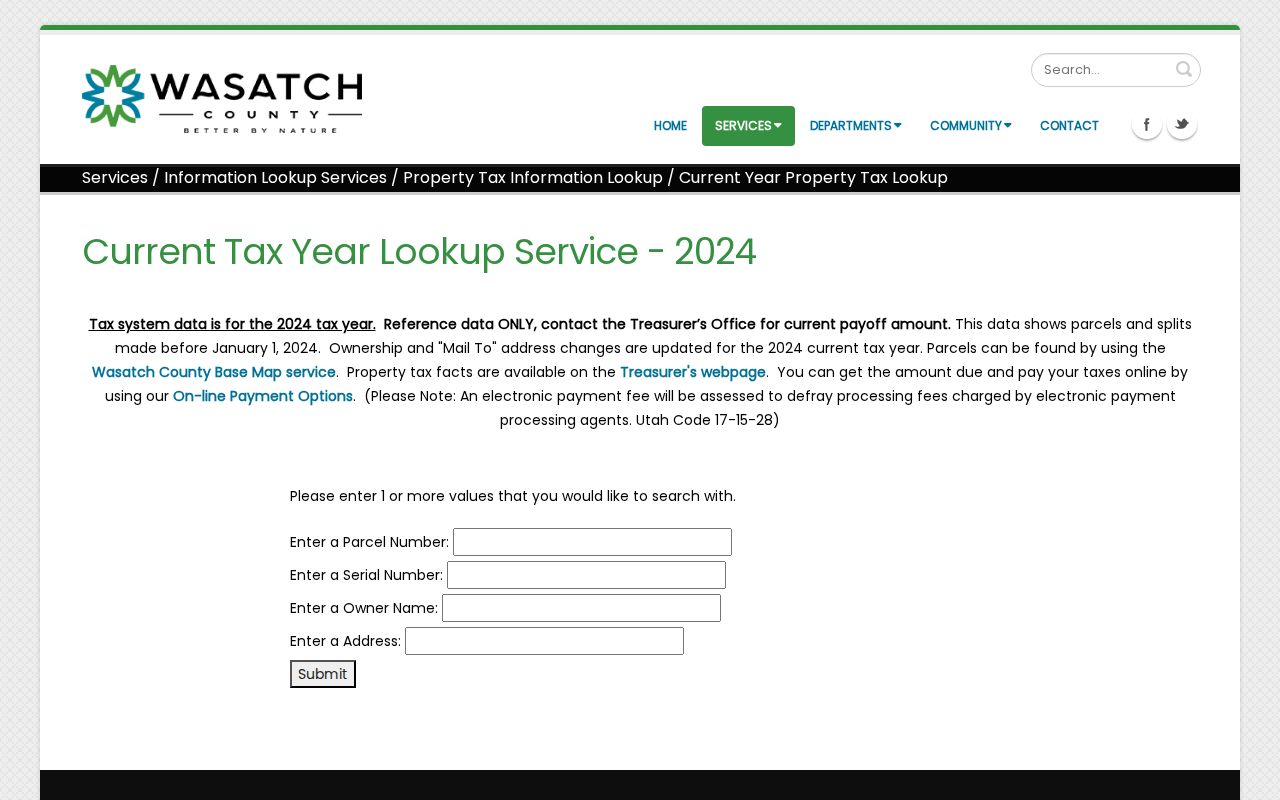
The current-year lookup offers four optional text inputs. The page states that one or more values may be entered. It says nothing about exact versus partial name matching. So test one supported key at a time if a result comes back muddy. The page itself labels its contents as 2024 tax-year reference data.
| Owner Name | Searches the tax owner-of-record field; matching behavior is not stated. |
|---|---|
| Address | Searches a situs/address key; street syntax is not stated. |
| Parcel Number | Connects a mapped parcel to its tax record. |
| Serial Number | Identifies the tax account. |
Wasatch County Owner Record Sources
Ownership clues live in several places. The assessor roll holds a piece. Recorder indexes, plat maps, and now and then a probate or court file hold pieces too. Begin with the tax roll for the current tax owner. Then pull the instrument or case that explains the transfer itself. A GIS map helps you pin down the parcel with confidence. A court record may explain a judgment or an estate event. But it still has to be tied back to the parcel and the Recorder filing before it proves anything.
| Source | Owner Info It Gives | Access |
|---|---|---|
| Assessor tax roll | Owner name and Mail To context for a tax parcel | Public current-year lookup; inspected page is 2024 reference data. |
| Recorder indexes | Recorded grantor, grantee, and vesting instrument references | Recorder office, indexes, map, and separate remote subscription. |
| County GIS | Parcel location and identifiers that connect to tax records | Public county map tools. |
| Utah Courts or probate file | Case context for judgment or estate transfer | State court tools and local clerk file when needed. |
These sources identify records and the parties recorded on them. They do not reveal who is physically present at a property, who benefits behind an entity, or whether every interest was ever recorded. Search the specific parcel rather than a person's name. Verify the latest transfer with the Recorder.
When a Trust or Estate Holds Title
A Wasatch County deed may name a trust, an LLC, an estate, or a personal representative as the grantee. Probate creates transfers too. Those transfers arrive through a personal-representative deed, an affidavit of surviving joint tenant, a deed of distribution, or an estate sale. None of those labels is necessarily the person who arranged the purchase. Nor is it necessarily the person who reads the mail.
Read the recorded instrument. It shows the role in which the party took title. Probate may explain a change. Utah Courts case records may then connect the estate to the deed. County sources publish no complete probate portal field inventory. The title question may turn on the case details. If so, request or inspect the actual court file through the court process.
Wasatch Parcel Numbers Set the Match
Searching by address or name can return several candidates. Parcel and serial numbers sharpen the match. They apply across the tax lookup, the county map, and recording requirements. For a subdivision or condominium, keep unit, lot, shared-area, and storage identifiers distinct. A parcel split can change the tax key. Older deeds still carry the earlier legal description, so watch for that mismatch.
When the address is incomplete, select the site on the county map. Note the parcel ID. If the map gives no clear result, call or visit the Recorder. Bring the best location details you have. Staff can share limited information about current ownership and the last vesting document. They will not supply metes-and-bounds legal descriptions over the phone.
Confirm the Last Vesting Document
A phone call to the Wasatch County Recorder can settle one narrow question. It concerns the last vesting document on a parcel. Staff read limited details from the screen. Expect the parcel number, the owner of record, acreage, and the last vesting document. Metes-and-bounds descriptions are not given by phone. Ask for the document reference anyway, then inspect the copy. Or buy one from the office.
This is the key handoff in an owner search. The tax roll points to a current owner. The deed is the recorded transfer that proves it. Owner fields and their update limits are explained in current Wasatch County owner records. Read the deed image whenever the exact grantee or legal description matters. Wasatch County property records reward that extra step.
Future Changes and Owner Alerts
Property Watch is a free service. It sends email notices when the Recorder records a deed, lien, or other instrument. That makes it a useful follow-up. A notice tells you something was recorded. It does not prove fraud, and it never replaces reading the instrument itself. Verify anything unfamiliar with the Recorder first, using the official contact details.
A blank or stale owner field also needs context. The tax lookup's notice describes 2024 data. It says ownership and Mail To changes were updated for that year. The lag between a closing and a tax-roll update is not published. So a new deed can outrun the tax entry in Wasatch County.
Limits of a Wasatch Owner Search
A public owner lookup answers one thing. It gives the name in the record. It will not reveal who lives at the Wasatch County address, who holds the keys, or who benefits from an entity. Utah law opens records classified as public. Private or protected details can be withheld or redacted. The Recorder's page carries redaction and unredacted-copy request links, so follow those official rules rather than republishing personal contact details.
A missing government document takes a GRAMA request to the custodian who keeps it. Wasatch County's public-records page lists a request route and a records contact at 435-654-2909. Describe the existing record specifically. GRAMA does not turn a clerk into a private investigator or force the county to name the person behind a trust. If a field is protected, use the lawful process and respect its result.
Some names will not tie to a parcel online. For those, the Recorder's counter at 25 N. Main St. in Heber City opens its public records. Computerized, microfilmed, and book records are all there. Phone staff can identify the parcel, current owner, acreage, or last vesting document shown on screen. They will not complete the chain of title. Nor will they read a metes-and-bounds description aloud. Those limits keep a Wasatch County call a bridge to a document request, not an ownership opinion, and the right deed settles the rest.
Lawful use. A Wasatch County owner lookup is for property research, diligence, and civic use. Do not use a name or address to stalk, harass, threaten, or target a person.