
Wasatch County Tax Record Fields
Every number in a Wasatch County tax record answers a different question. Real property is valued at 100% of fair market value as of Jan. 1. Meet the stated occupancy rule, and a primary-residence exemption applies. That exemption drops taxable value to 55% of market. The Treasurer's amount due is a further step. None of these figures is a sale price. Treat each one as a stage of the bill. It is not an appraisal or a current payoff.
| Field | What It Shows | Where |
|---|---|---|
| Market value | Assessor’s full fair-market-value estimate as of Jan. 1 | Assessor valuation and annual roll |
| Taxable value | Value used for tax after an approved exemption or classification | Assessor roll and exemption record |
| Tax bill | Annual amount assessed for the parcel | Treasurer tax services |
| Payment and payoff | Payment status or current payoff amount | Confirm directly with Treasurer |
| Appeal status | Valuation review through the Board of Equalization process | Clerk/Auditor and County Council |
Market value and taxable value are not the same number. The assessor's Jan. 1 estimate stands regardless. The 55% primary-residence treatment changes only the taxable base. A deed's recorded consideration, where one exists, marks a single sale event. The tax bill then combines that taxable base with the year's rates and charges.
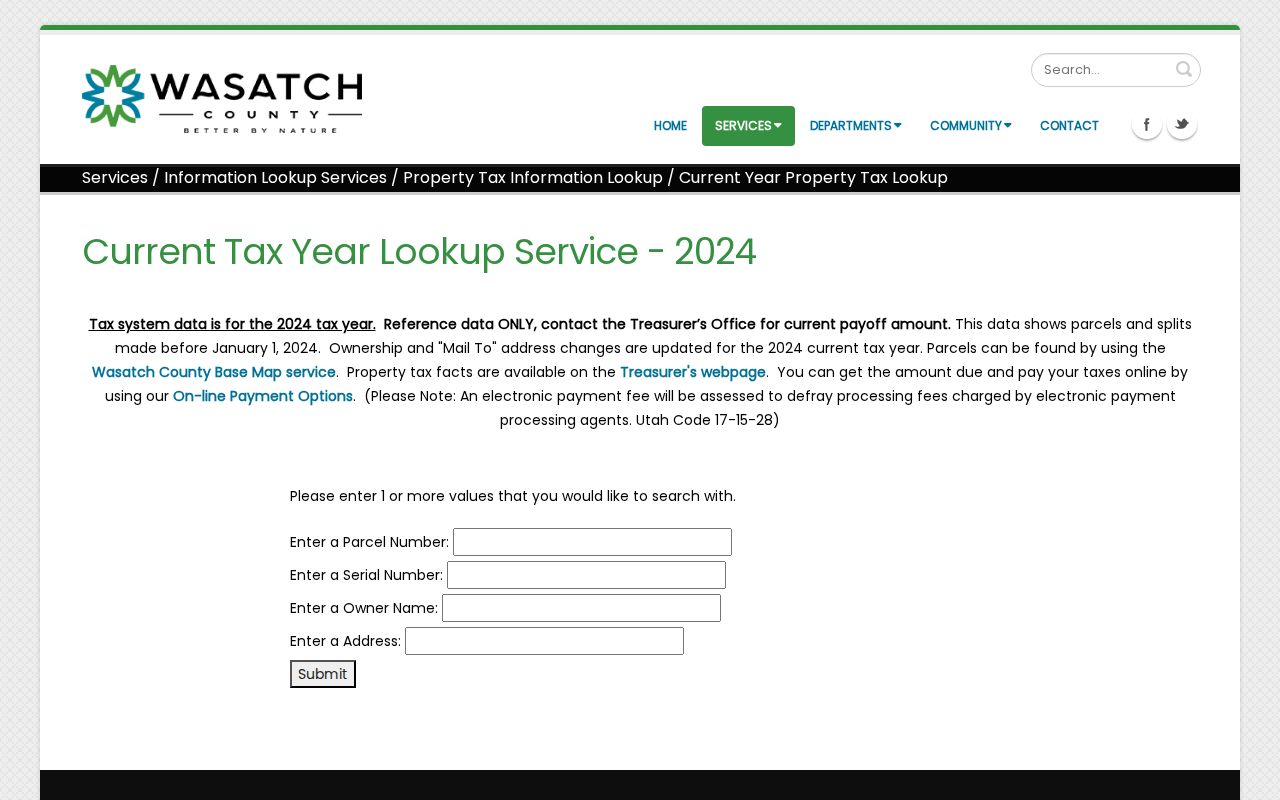
Wasatch Tax Lookup Search Fields
The county's current-year lookup takes any mix of values. No search field is required. What it returns is reference data, not a promise that a tax bill or payoff is current. A parcel split or ownership change after the stated 2024 coverage limit will not appear there.
| Input | Type | Required | County Note |
|---|---|---|---|
| Parcel Number | Text | Optional | County parcel identifier. |
| Serial Number | Text | Optional | Tax serial identifier. |
| Owner Name | Text | Optional | Matching behavior is not stated. |
| Address | Text | Optional | Street syntax is not stated. |
When the address is unclear, search by parcel number or serial instead. For a payoff good today, ask the Treasurer rather than trust a reference result.
How the Wasatch Tax Calendar Moves
The tax year turns on a few fixed dates. Valuation starts with the Jan. 1 lien date. The assessment roll closes May 22. Notices go out in July. Board of Equalization appeals run Aug. 1 through Sept. 15. Tax notices are mailed Oct. 30, and payment is due Nov. 30. A separate primary-residence application also closes Sept. 15.
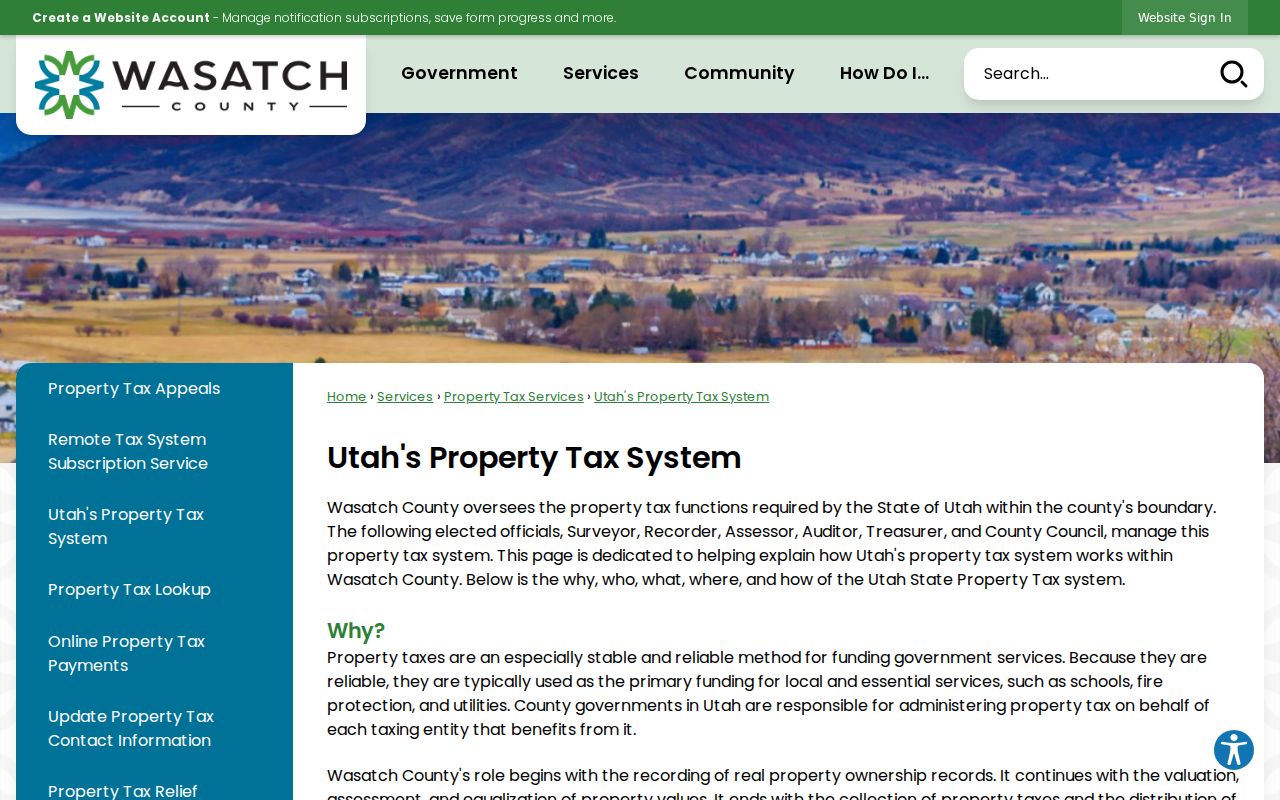
The county tax-system page maps each handoff. The Assessor values property and prepares the roll, the Clerk/Auditor applies rates and clerks the BOE, the County Council hears valuation appeals, and the Treasurer bills, collects, and distributes the revenue. A value fight goes through the appeal path. Amounts due, delinquencies, and payoffs belong to the Treasurer.
Finding a Wasatch Tax Bill
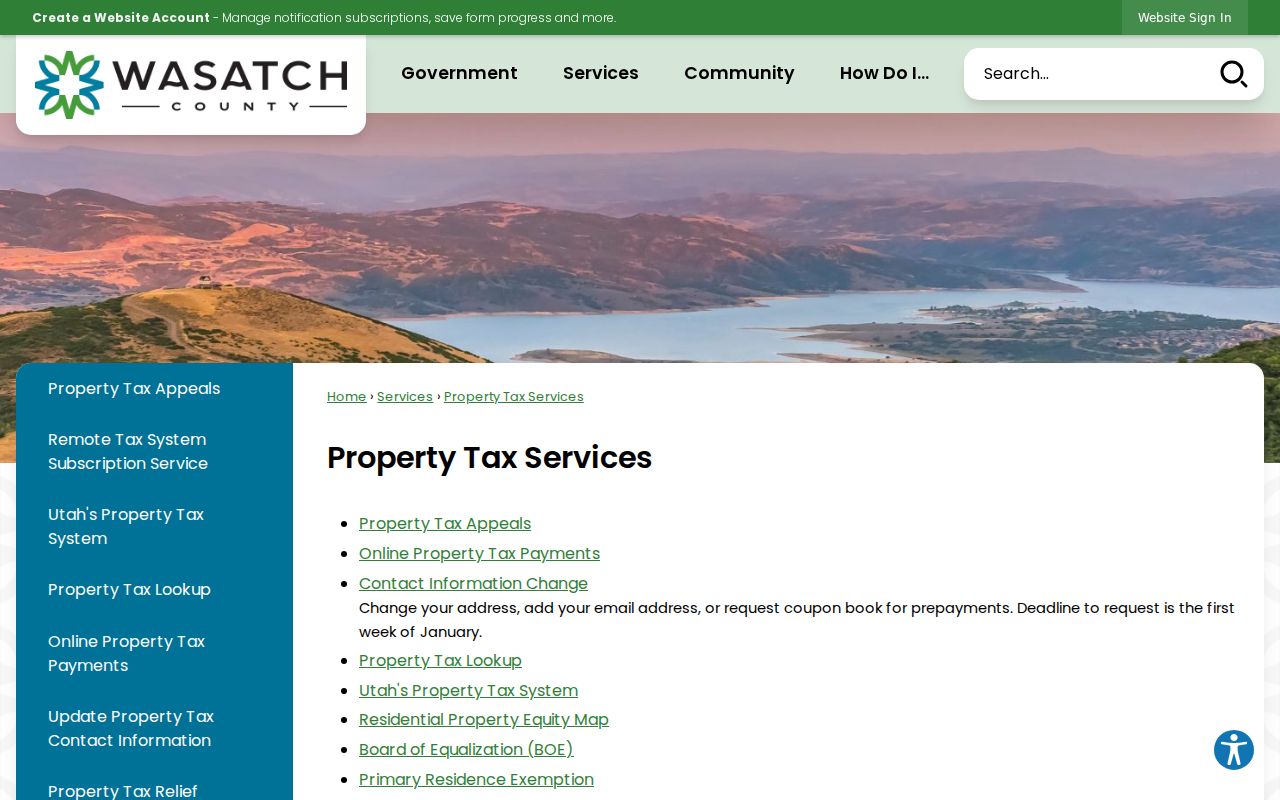
The county tax-services page links the property lookup, payment, tax sale, relief, appeals, parcel map, and document tools. Start with an address, parcel number, or serial. Keep the tax year attached to any result. Call the Treasurer when a closing, payoff, delinquency, or redemption turns on today's status. The online lookup is for reference only.
- Open Wasatch County Property Tax Services and choose the lookup or payment route that matches the task.
- Search by address, parcel number, or serial number and note the tax-year label.
- Check the assessor record for an exemption or classification that changes taxable value.
- Contact the Treasurer for current payoff, delinquency, payment, or tax-sale status.
- Market value
- The assessor’s estimate of fair market value on the Jan. 1 valuation date.
- Taxable value
- The base used to compute tax after an approved exemption or classification.
- Primary residence exemption
- Qualifying primary use can reduce taxable value to 55% of market value.
- Tax payoff
- The amount the Treasurer confirms for payment at a particular time.
Primary Residence at 55 Percent
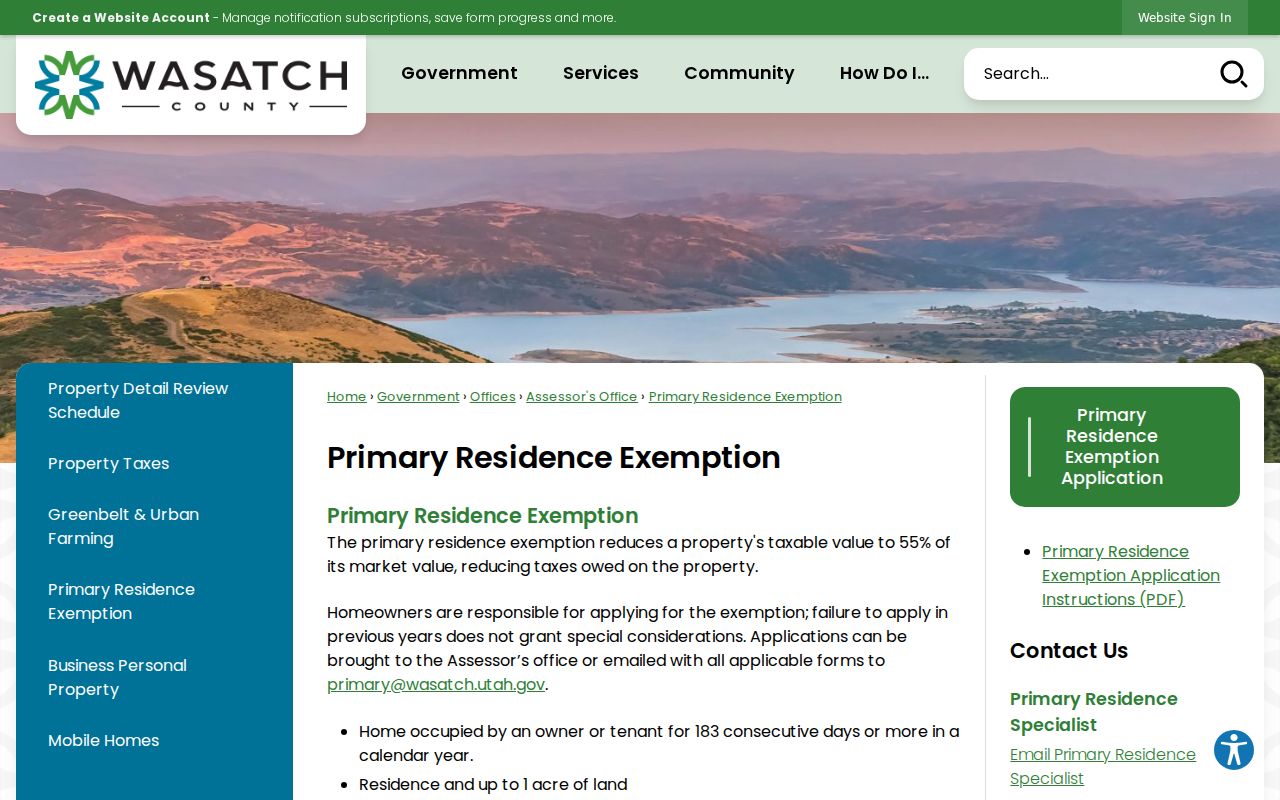
Wasatch County's primary-residence exemption cuts taxable value to 55% of market value once the 183-day occupancy rule is met. Applications are due Sept. 15. The exemption changes the taxable base only. The assessor's full market-value estimate stays put. After a transfer, confirm the parcel's status through the official county route rather than assuming the exemption carries over.
The county application page has the current filing details. Greenbelt and urban farming are separate programs. Both use productive capacity for qualifying land under their own conditions, and a parcel's appearance or prior-year exemption proves nothing about the current year.
Greenbelt and Urban Farming
Greenbelt and urban farming are classifications for qualifying productive use, valued on productive capacity rather than as ordinary residential land. Wasatch County describes both programs this way. Eligibility is parcel-specific. A rural look or an old classification proves nothing about today's result. The application terms follow the land, not the neighborhood.
When a tax value changes, line up market value, taxable value, property class, exemption status, and assessment year. A parcel split can move the bill. So can an improvement, a reclassification, or the annual revaluation, all without a deed sale. The assessor or clerk office named in the county tax services directory can explain the change.
The labels matter where rural and residential land meet. The primary-residence exemption turns on the owner's use and the 183-day test. Greenbelt turns on qualifying productive land. One parcel may need both checks. Market value, taxable value, and tax due are related entries, not interchangeable measures. Apply through the county instructions for the program shown.
Wasatch Tax Sale and Delinquency
Wasatch County Property Tax Services covers the tax bases. It pulls together the tax-sale page, online payments, the current-year lookup, and Treasurer contact details. For current sale terms and parcel lists, that county page is the authoritative stop. The county publishes no stable delinquent-parcel export and no standing bidder terms. Confirm redemption wording and bidding rules with the Treasurer. Do not rely on an old notice.
Real-property tax notices go out Oct. 30, and payment is due Nov. 30. A lookup result can help you identify a parcel and its tax account. It is not a payoff quote. The same caution applies to delinquency records. A tax-sale entry alone does not establish who owns a Wasatch County property now. Confirm status, and review any resulting deed, with the office that holds the record.
Paying online is separate from checking a balance. Utah Code §17-15-28 lets the county charge an electronic-processing fee for online payments. A payment confirmation is not a payoff statement. A closing may need the amount due on a specific date. Request that figure from the Treasurer. The tax-sale page carries current notices and terms. If ownership changes after a sale, the recorded tax-sale deed is the land record to examine.
Appealing a Wasatch Assessment
A Wasatch County owner who disputes a valuation can appeal to the Board of Equalization between Aug. 1 and Sept. 15. The County Council hears these valuation appeals. The Clerk/Auditor serves as BOE clerk. Start with the notice in hand. Identify the parcel and the valuation year, then follow the county's appeal instructions for how and where to file. The county sets no published evidence checklist. Do not assume any particular form or attachment is required.
Keep valuation and payment questions separate. An appeal challenges the assessor's value; a payoff request belongs to the Treasurer. A tax record should show the assessment year and surrounding value context, while the county's current pages supply the filing route. If a value jump followed a new improvement, a split, or a classification or exemption change, gather the record documenting that event first.
For a cleaner review, keep the valuation notice, parcel number, tax year, current class, exemption line, and the value fields from the assessor record together. Compare them against the county's Jan. 1 valuation date and the May 22 roll close. A later deed or improvement does not automatically explain a value set on an earlier assessment date. Treat these items as comparison notes only. The County Council and Clerk/Auditor instructions govern the actual filing requirements.
Appeal window. Wasatch County lists Aug. 1 through Sept. 15 for BOE appeals. Check the current county instructions and submit within the stated period.