
Wasatch County Owner Record Fields
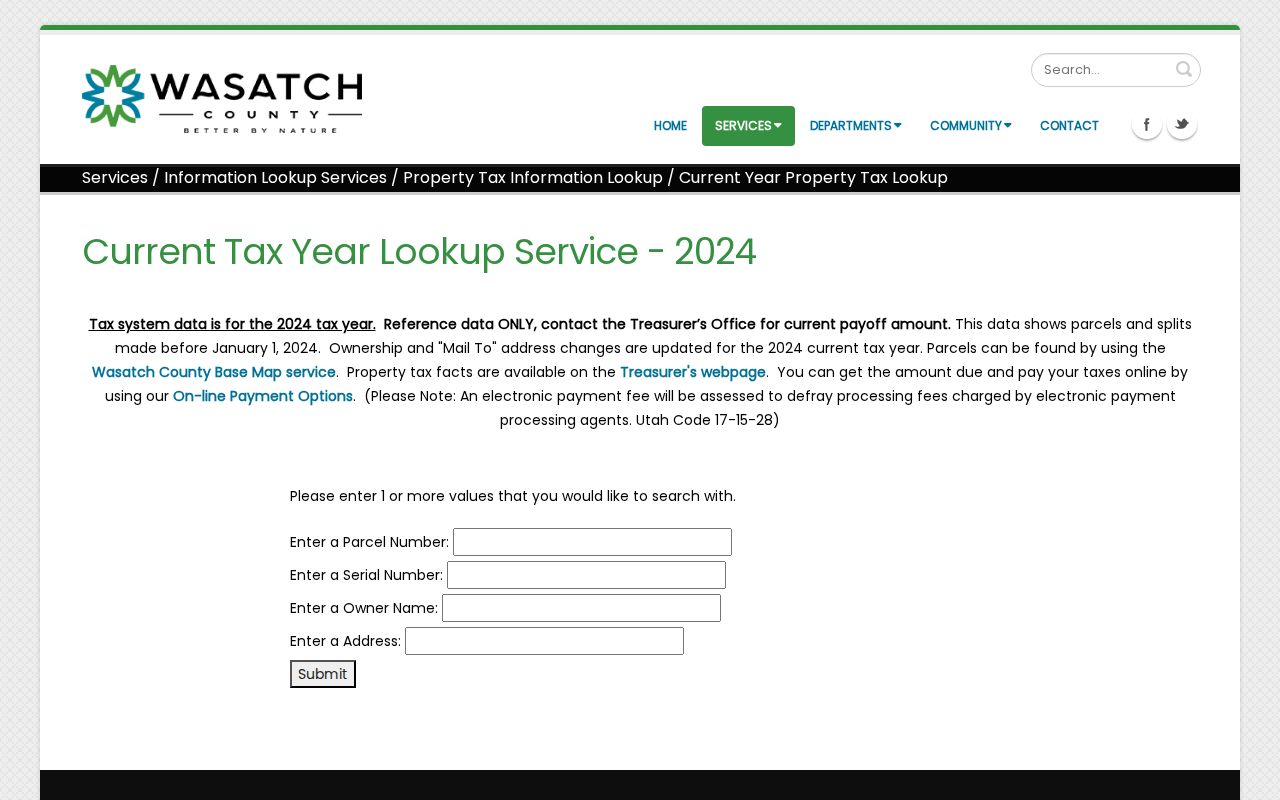
The county's tax lookup page documents its search fields and its update note, but it displays no complete sample result card. That gap matters. Some owner details must come from a recorded instrument rather than the tax screen. Start with the tax owner name and parcel identity. The deed supplies the formal vesting language.
| Owner Name | Documented as an optional tax-lookup search input; result-card format is not published. |
|---|---|
| Mail To | The 2024 coverage notice says mailing changes were updated for that tax year. |
| Address | Documented as an optional lookup input, but exact address syntax is not stated. |
| Parcel Number | Documented as an optional search key that helps tie a result to a mapped tract. |
| Serial Number | Documented as an optional tax-account identifier. |
| Vesting deed | Confirm grantee and legal description in the newest recorded instrument. |
Owner of record means the party named in the tax system. It is not the occupant. Nor does it reveal the beneficial owner behind an entity. Mail To is a correspondence field. It is not proof of residence. For a property matter, use a lawful written contact route, and do not republish the mailing details from the account.
The Wasatch Roll’s 2024 Limit
The current-year tax lookup labels its data as 2024 reference information. It covers parcels and splits before Jan. 1, 2024. Ownership changes were updated for that tax year. The label is a ceiling. A later closing or parcel change can reach the Recorder before it reaches the tax screen, since the county publishes no exact lag. The roll is not a real-time ownership feed.
For a payoff figure, the county directs users to the Treasurer. For current ownership, go to the Recorder's most recent vesting document. Keep the tax year beside the owner name. That habit keeps a past record from being mistaken for a present transfer.
Owner, Mail To, and Situs
Three labels should stay separate in a current-owner check. Owner Name is the tax record's ownership clue. Mail To is where tax correspondence goes. Address is the situs field that locates the real property itself. These fields can differ without any error. An owner can hold land here while receiving mail in another state, and an entity can be the named grantee even when an individual manages its affairs.
Compare all three with the parcel or serial number. A name alone can match another person or a similarly named company. A mailing destination never shows who lives at the parcel. If the tax information conflicts with a newly recorded deed, trust the deed and ask the Recorder or Assessor to explain the update path.
Confirm a Wasatch County Owner
The strongest current-owner check compares the tax owner with the newest vesting instrument. The Assessor's entry is a practical first clue. The Recorder keeps the documents that transfer real-property interests. Staff there can identify the last vesting document shown on screen. Save the parcel, serial, and recording references. That lets a later review repeat the same match.
- Find the parcel in the Wasatch County tax lookup and record the Owner Name, Mail To, situs, and tax year.
- Ask the Recorder for the last vesting document and its limited recording references.
- Inspect the instrument and match the grantee and legal description to the parcel.
- If the grantee is a trust, company, or estate, read that stated role and use the relevant official entity or court record.
- Owner of record
- The name associated with the current tax account.
- Vesting
- The way the deed states an interest is held or transferred.
- Grantee
- The party identified as receiving the interest in a deed.
- Situs
- The parcel’s location address, distinct from the Mail To address.
After a Recent Wasatch Closing
A fresh closing may not appear right away in the tax lookup. The county publishes no set lag. Recording and roll updates run on separate clocks. For a recent transfer, the newest recorded deed is the better source. The tax record still gives parcel and account context. Check the recording date. Confirm the instrument covers the same legal description.
Suppose the deed is there, but the tax owner still shows the prior name. Ask the Assessor how the roll update is handled. If the deed is not found online, the Recorder offers public counter access to computerized, microfilmed, and book records. A failed web search settles nothing. The document may still be recorded.
For a live mismatch, contact the office that owns each field. The Assessor, at 435-657-3221, handles the current roll. The Recorder, at 435-657-3210, handles the transfer. Both offices sit at 25 N. Main St. in Heber City. Counter access runs Monday through Friday, 8 a.m. to 5 p.m., closing for legal holidays and the first-Friday-in-August County Fair Day. Give staff the parcel and serial numbers, not just a street address.
The 2024 lookup note ties ownership changes to that tax year. No day count is stated. Carry the closing date, the newest vesting instrument's date, and the tax-year label together in any current-owner check. That shows which source is newer.
Trusts, Companies, and Estates
Wasatch County deeds sometimes name entities instead of people. An LLC, trust, or estate may hold title. Probate transfers take several forms. Personal-representative deeds, deeds of distribution, affidavits of surviving joint tenants, and estate-sale documents all show up in Wasatch County property records. The grantee line shows who received the recorded interest. It seldom shows who actually benefits from the arrangement. Utah entity and court records help only to the extent of clarifying the legal name and the role attached to the parcel. Do not infer beneficial ownership from an address, a company name, or a mailing contact, and for an estate transfer, weigh both the probate case and the recorded deed.
Wasatch Recorder Phone Confirmation
Phone answers from the Wasatch County Recorder are deliberately narrow. Staff can read out a parcel number. They can also share current ownership, acreage, the last vesting document on screen, and limited recording details. Metes-and-bounds descriptions are off limits by phone. A call helps when online results stay unclear. It is not a title search. Nor is it an interpretation of the document.
For the instrument itself, visit the office for public inspection. Or ask about purchasing a plain or certified copy. Certified copies come from the Recorder. The fee page lists a $5 certificate under seal and $1 for additional copy pages. No separate total deed-copy price appears. Split the question between offices. The Assessor contact handles the tax roll and tax bill side. The Recorder contact handles the vesting deed and deed records.
Both offices sit in the Administration Building at 25 N. Main St., Heber City. The Recorder posts 8 a.m. to 5 p.m. on weekdays. It closes on legal holidays and for the half-day County Fair Day. If a call points to a recorded instrument, inspect or request that instrument. Treat the name as the owner of record only after that.
Wasatch Owner Contact Limits
Public owner information from Wasatch County property records suits a defined property matter. Think a boundary question, a purchase inquiry, or a request to resolve shared access. The Recorder does not guarantee accuracy, reliability, or timeness of its data. Its site links to redaction requests and unredacted-copy requests. The public page does not list every eligibility rule. Follow the official forms, and do not copy private contact details into any new directory.
Lawful use. A current Wasatch County owner lookup supports property research and due diligence. Do not use the name or address to stalk, harass, threaten, or target anyone.