
Wasatch County Deeds and Instruments
Deed records in Wasatch County cover far more than deeds of sale. The Recorder indexes conveyances, deeds of trust and mortgages, assignments, releases, easements, restrictions, liens, notices, final judgments or decrees affecting title or possession, and plats. Read the document type first. A recorded lien burdens an interest. A release may show the lien was cleared. A plat defines a mapped lot arrangement. Treat none of these as a deed transfer unless the instrument itself conveys an interest.
| Deed Type | What It Does | Common Use |
|---|---|---|
| Conveyance deed | Records a transfer of a real-property interest | Confirm a vesting change and its legal description. |
| Estate or representative deed | May transfer property from an estate or personal representative | Connect a probate transfer to the deed chain. |
| Deed of trust or mortgage | Records a secured loan or lien against property | Identify an encumbrance, not a new owner. |
| Assignment or release | Changes a secured party or records a release/reconveyance | Check whether a prior lien was transferred or cleared. |
| Judgment, easement, or plat | May affect title, possession, access, or parcel layout | Read the specific terms and cross-reference the parcel. |
Not every recorded paper is a deed. A deed conveys an interest in land. A mortgage, deed of trust, or lien usually records a claim or security interest instead. A final judgment can affect title or possession without ever functioning as an ordinary sale. The Recorder’s index is where you locate these filings. The instrument image plus its legal description tell you what was actually recorded.
Wasatch Land Books Begin in 1862
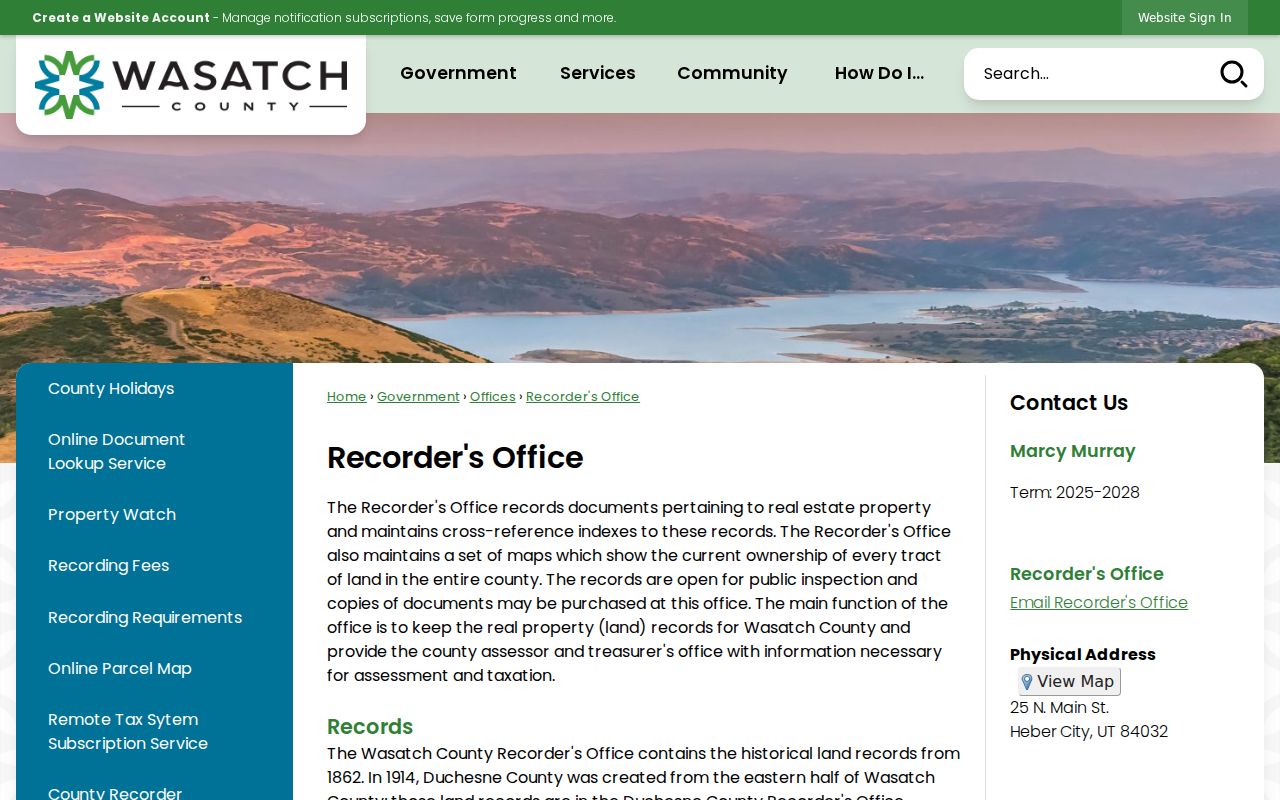
The county Recorder dates its land records to 1862. The collection spans computerized records, microfilm, and book volumes. Many original books sit off-site in a vault. Search and copy work happens at the Recorder’s counter. That 1862 date describes the county’s holdings, not any online cutoff. The county publishes no earliest year for its current web interface.
When a digital result comes up empty, work the tract references and cross-indexes at the counter, ask about microfilm or book-format material, and consult the Utah State Archives catalog. The Archives holds permanent Wasatch County abstract books, reverse indexes, and indexes to records. No courthouse fire or major loss appears in the official record. Test any gap across the record formats rather than blaming an assumed disaster.
What the Wasatch Archives Index Holds
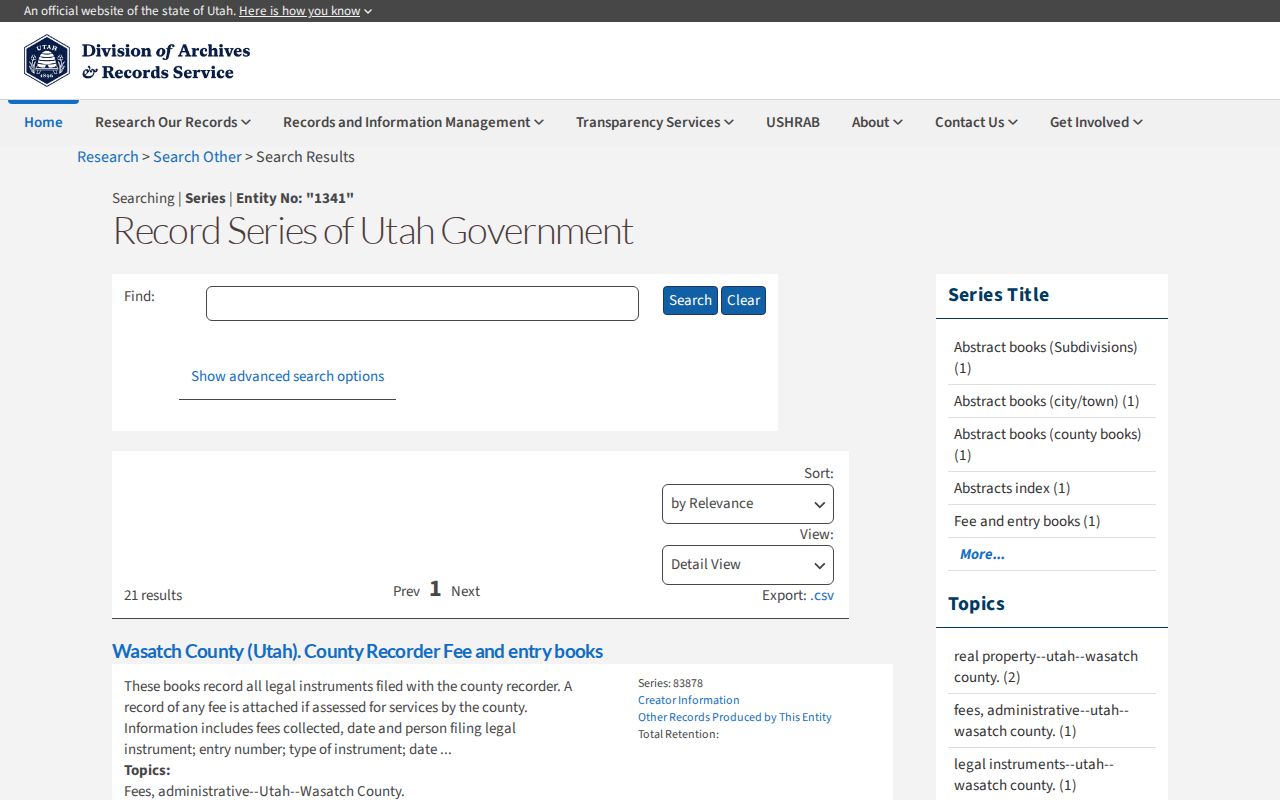
The Utah State Archives catalog describes Wasatch grantor and grantee indexes along with abstract books. A grantor entry records the transferring party. A grantee entry gives reverse access by the receiving party. The sample inventory lists entry number, names, and instrument date and time. It also lists instrument kind, book and page, and a brief description. Abstract books organize a geographic chain. They note instrument date, character, reference numbers, and related property history.
The Archives finding aid also points to microfilm and older index material. This includes mining-claim and general-record indexes. Identify the series and format in the catalog before visiting or filing a request. The catalog is a guide to permanent record groups. It does not replace checking the actual instrument with the Wasatch Recorder. Nor does it confirm which county holds jurisdiction after the 1914 split.
Reading the Wasatch Grantor Index
The Wasatch Recorder maintains cross-reference indexes for every recorded instrument. Direction matters when you search names. A grantee search shows when a party received an interest. A grantor search reveals a later transfer from that same party. The official page does not publish the live field list or the earliest online year. Never assume a web search reaches back to 1862.
- Start with the parcel’s current vesting document or the last deed shown by the Recorder.
- Record the grantee, grantor, instrument kind, date, entry number, and book/page reference.
- Use the names and parcel description to check the cross-reference in the opposite direction.
- If the web trail ends, ask for computerized, microfilm, book, or abstract records at the counter.
- Grantor
- The party named as transferring an interest in the instrument.
- Grantee
- The party named as receiving that interest.
- Chain of title
- The ordered record of instruments that link past transfers to the present vesting.
- Entry number
- A Recorder index reference; book and page may provide a separate volume location.
Duchesne County’s 1914 Line
In 1914 the eastern half of Wasatch County became Duchesne County. Those eastern-area land records moved to the Duchesne Recorder. That split is a practical break in any historical chain. An old deed or legal description placing land east of the former line may name Wasatch. Yet the current Wasatch office will not hold every later record.
Match the old description to current geography before drawing conclusions. Test the correct county first. This matters most when a chain jumps between offices. It also matters when the modern parcel number no longer matches the historic tract. The county's 1862 holdings are real and deep. They do not erase the jurisdiction change. For modern conveyances, use the recorder whose present boundary contains the land.
Wasatch Recording Fees in 2026
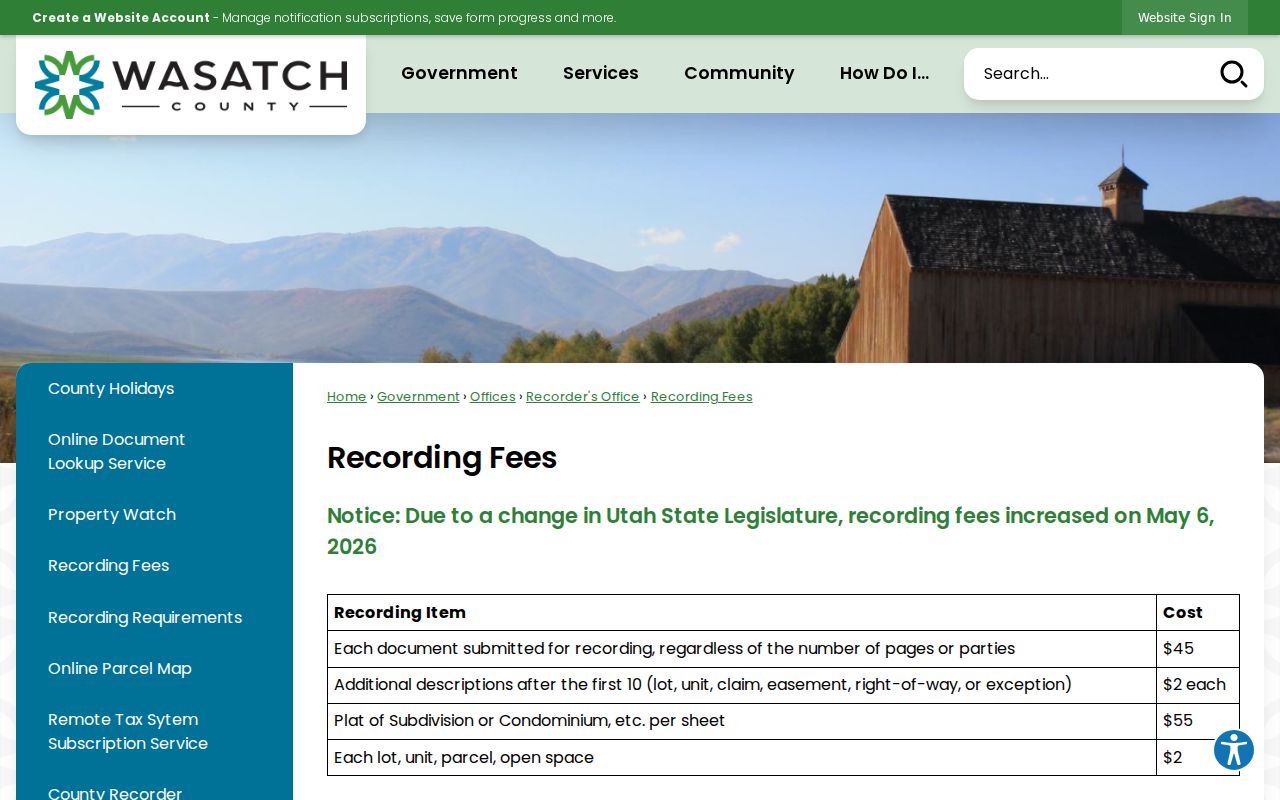
The Recorder fee page shows a change effective May 6, 2026. Recording fees differ from the cost of an image or certified copy. The posted schedule lists a statewide instrument charge. It adds separate fees for parcel descriptions, plats, certificates, and extra copy pages. Check that schedule before submitting documents. The fee page is the county’s current reference.
| Recording instrument | $45 per instrument, regardless of pages or parties |
|---|---|
| Descriptions | $2 per description after the first ten |
| Subdivision or condominium plat | $55 per sheet, plus $2 per lot, unit, parcel, or open space |
| Certificate under seal | $5 |
| Additional copy pages | $1 per page; separate total copy pricing was not displayed |
Wasatch Deed Recording Requirements
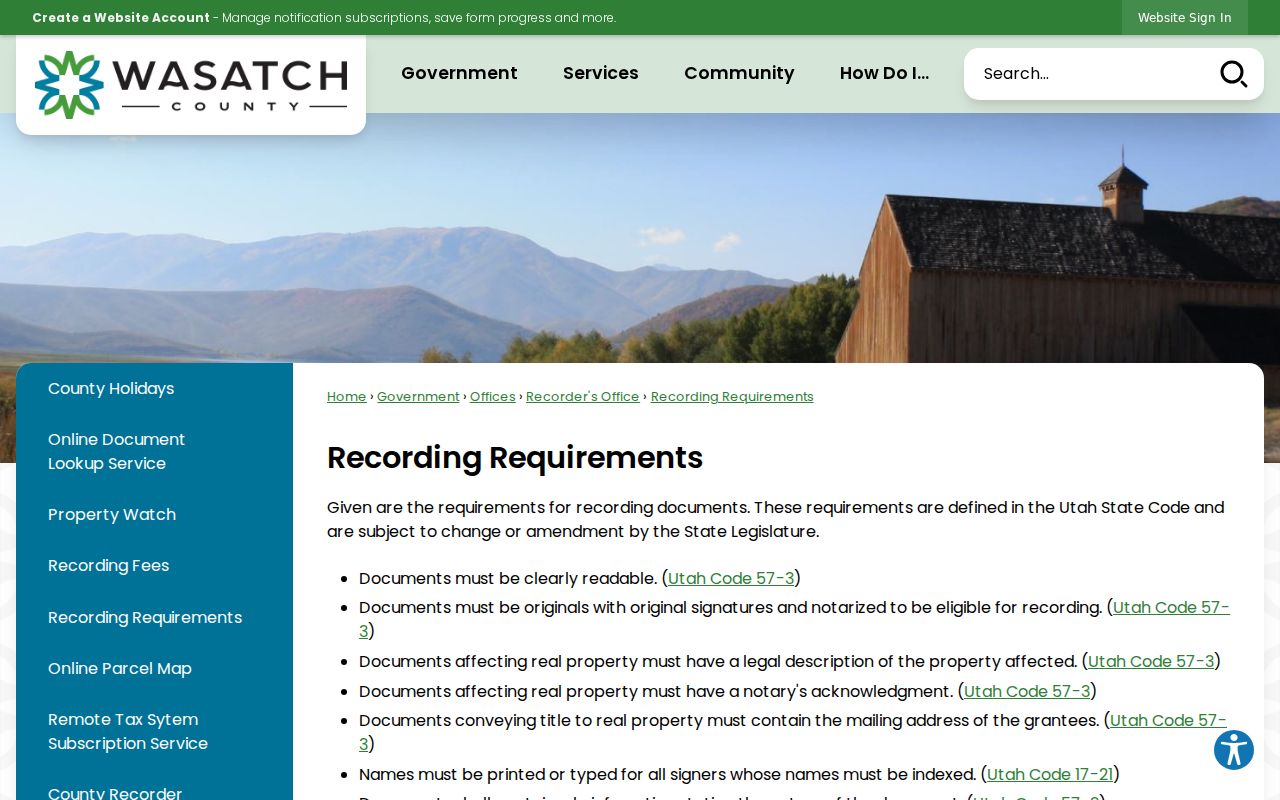
Utah Code §§57-3 and 17-21 back the county's recording rules. A deed going into the Wasatch County property records must be legible. It must be signed in original ink and notarized. Every instrument needs a legal description plus the notary's acknowledgment. The caption has to say what the document is. Any deed that conveys title must also list each grantee's mailing address. Names being indexed must be printed or typed. One more detail matters: each parcel in the instrument needs its tax serial number.
Meet these rules and the recorder will accept the deed for filing. That is all they promise. The requirements say nothing about whether the deed actually transfers good title. A legal description also cannot stand in for a street address. When a parcel has been split, the document must pin down the right lot, unit, or parcel number. The same holds for a condominium unit. For drafting questions, rely on the Recorder's published requirements. Then talk to a qualified professional. Office staff cannot write or interpret an instrument for you.
Wasatch Property Watch After Filing
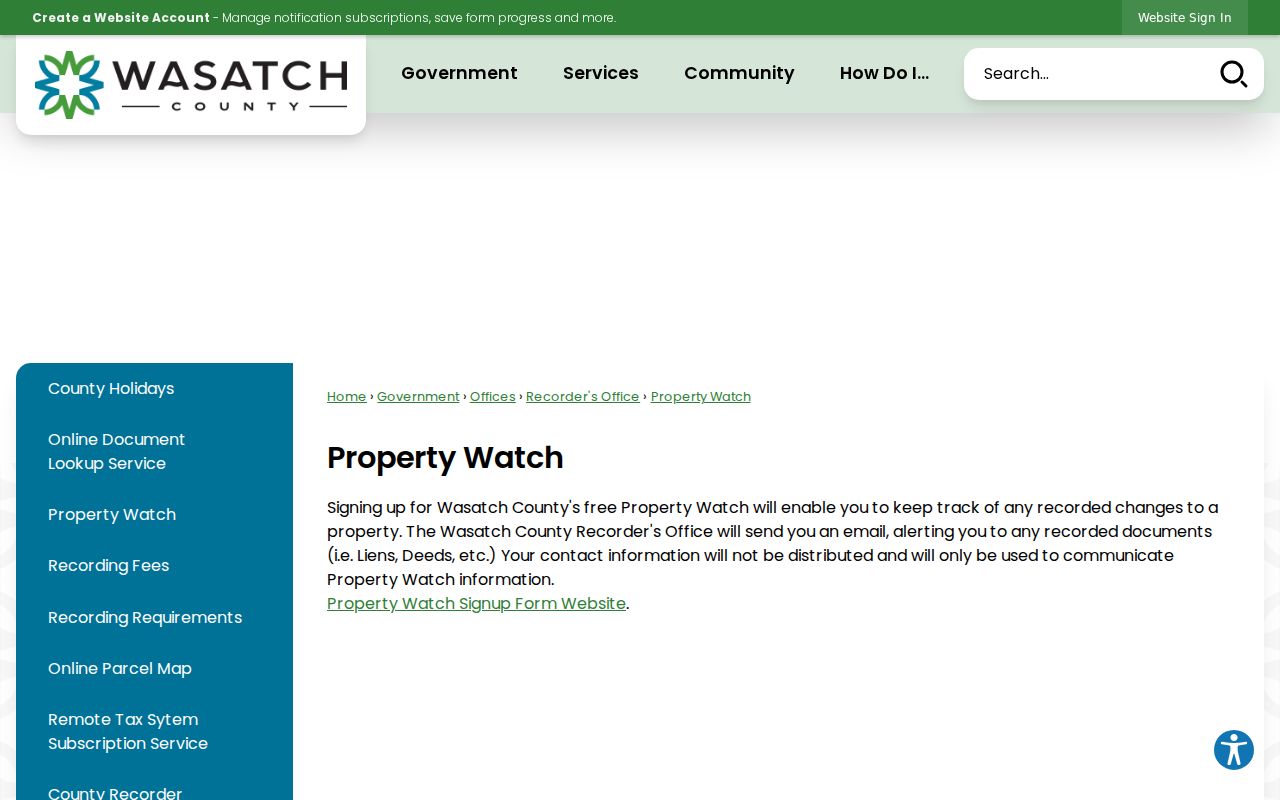
Property Watch is the county's free email alert service. It notifies subscribers whenever a document enters the record, including deeds and liens. That makes it handy right after you record a deed. It can flag a later matching filing against your parcel. Treat the alert as a heads-up, nothing more. Pull the actual document and call the Recorder if anything looks unfamiliar. The service will not catch every name variation. It is no substitute for a real title review.
Sign up through the official county service. Contact details supplied at enrollment are used only for Property Watch communications. This is the case under the county's own terms. The tool fits neatly into the wider Wasatch record system. The Recorder's index documents filings already made. The alert tells you when a new one arrives.
Obtaining a Wasatch County Deed
Public inspection is free at the counter, and copies cost money. Staff can pull up a last vesting document on screen. They will give limited recording information by phone. But they will not read a metes-and-bounds description over the phone or run a full title search. For a certified copy, contact the office and use the references in the index. The fee page shows a $5 certificate under seal. It charges $1 for additional copy pages. It does not list a complete deed-copy total.
Remote access is a paid service on its own. Wasatch charges $1,750 per year for tax-system access. It offers an optional $1,150 recorder map and index package. It adds a $1,000 setup fee for a new or expired account. The contract includes scanned tract indexes and ownership maps. It also covers old tax cards, articles of incorporation, and recorder map and index documents. A one-time public request and a professional subscription are two different routes.
A single instrument usually starts at the counter. Bring the parcel. Bring the party names. Bring any book, page, or entry reference you already know. The Recorder's office sits at 25 N. Main St. in Heber City. Hours are Monday through Friday, 8 a.m. to 5 p.m. It is closed on legal holidays. It also closes for a half-day on County Fair Day, the first Friday in August. The county lists Recorder@wasatch.utah.gov and 435-657-3210 for contact. Phone help has limits, so plan to inspect or request the document itself.
Recorded, not guaranteed. A Wasatch County deed record shows a filing and its stated terms. It is not a title opinion, and a complete chain may require older indexes, probate records, or another county’s books.